Sunday, October 21, 2012

To String Or Not To String: That Is The Question

This is probably the question I am asked the most at this time of year. Between summer and winter seasons, we as players are left to ponder how strings and tension might be affecting our game. The debate is continually ongoing and there is never a right or a wrong answer.
The general rule of thumb is to restring your racquet each year the number of times you play in a week. If you play three times a week, the general rule would therefore be to restring your racquet three times. But even this general rule doesn't always work or make sense in relation to one's game.

So, you ask, what is appropriate?

To discuss the professionals, the trend has been to lower the string tension. Back in the day of Jimmy Connors or Pete Sampras, the tension would have been up near or even above 70 lbs. But nowadays, the tensions have been coming down. With powerful new racquets, there is no need to string as high as we once did. For example, the professionals probably use a new string job for just a set, if that. They may change more frequently. They have professional stringers on site to manage their many racquets and use string that is not always conducive to a game at club level. Strings deaden quickly at such a pace and frequency of hits. But what about us mere mortals on the court? How do we know when our strings are dead?

The number one priority in stringing for play at any level is the actual "playability" of your strings in conjunction with your game. Too often we look at what others are doing or what the professionals are doing in terms of string and tension, but that might not suit your own, personal game. 

If you hit with more topspin, you might look to restring a bit more as the strings become frayed as there is more gripping of the string required as it makes contact with the ball on each stroke. The more you hit low to high, the longer the ball remains on the strings. Oftentimes, customers come up to me and say, my strings are done - they are moving. Well strings do move and the pattern will change shape if you are hitting with a good amount of topspin. If you hit flat, you may get away with fewer restringings as the string stays intact longer as the ball is not on the strings for as long a period.

Different types of strings have various stretching tendencies. The popular Sensation or NXT from Wilson Tennis stretch a lot more than Wilson's Luxilon string, which is more wire-like. Strings that stretch offer more control but need to be replaced more often 

The answer to whether you should restring is a personal one based on use and type of string and how your game is progressing. The best way forward is to ensure that you feel comfortable with the strings in your racquet. If not, change them out and restring or test something new with a demo of your own racquet strung differently. But by lowering or raising your tension or changing string it's a whole new game. It's trial by play!

Sunday, September 30, 2012

The Ryder Cup

There's something about golf that's different this week. Golf has become one of the leading televised sports and week in, week out the PGA puts on a show. Sunday evenings find many millions of Americans, and foreigners too, huddled in the family room watching the sun set on another PGA event - will Rory McIlroy stay ahead or will one of the pack come up and take the trophy. From Congressional to The Masters, from Oakmont to The Fed Ex Cup - golf delays 60 Minutes here on the East Coast almost every week.

But it was interesting to hear this week the first time golf delayed 60 Minutes. In a recap of the 1991 Ryder Cup at Kiawah Island Golf Club in South Carolna, one of the PGA executives mentioned that network television stayed with the Cup coverage and delayed the network's programming for "The War On The Shore" as that year's Cup became known as it went down in lore as one of the greatest ever Ryder Cups.

What makes the Ryder Cup so enticing? Why was it that network TV decided to keep the cameras rolling? Why is it that I remember watching The Ryder Cup more than I do Wimbledon with my British friends during my years abroad?

Two reasons. First, The Ryder Cup is one of those rare times when professionals play for country rather than themselves. There is a higher desire, a greater good, a mightier meaning. It's so rare that the USA gets behind a team internationally. But The Ryder Cup is every two years on opposing sides of the foaming Atlantic. It's an international event and shows just how different the same game can be on different sides of an ocean. Churchill once said that Britian and America are two nations separated by a common language. We are also two countries, and now add Europe to the mix, separated by a common game: Golf. Deep down we know Tiger Woods doesn't enjoy playing a links course. And the Brits and Europeans just don't really understand Bermuda grass, the grass on most American putting greens.

This year at Medinah Country Club outside Chicago, Davis Love III, the American captain, has asked that the fairways be widened for his big hitters like Tiger Woods and Keegan Bradley. There's very little thick rough. The weather has been friendly with not much of a breeze with cool Autumn sunny days. You can wager that in 2014 at Gleneagles, nestled between Dundee and Loch Lomond north of Edinburgh, the wind will be whipping, the temperatures will be colder, and the rough will be thicker.

The second reason we love to watch the Ryder Cup is that the format is, well, just perfect. With professionals playing what we amateurs play every Tuesday morning while we skive off work, The Ryder Cup offers us, the viewers, a format we can relate to. It also puts the professionals playing against each other right in the same foursome - right there to stare down each other with a poker face while supposedly studying one's yardage notebook. The morning is a two-ball, alternate shot format, so different from the stroke play we see each week. The afternoon is a four-ball. Enemies on the tour are hamming and egging to win a point for their nation. What a change. It's a lot more like the Texas scrambles I like to play against my father's friends when I am home for the weekend. The only difference being there's no math at the end of each hole to figure out the handicaps with these guys at Medinah. If you're in the hole in 4, you're in the hole in 4. Oh yeah, one other difference: The shotmaking.

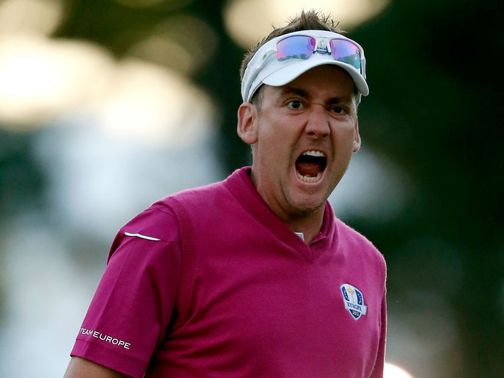
Ian Poulter reacting to abirdie putt.
Match play simply makes the opportunity for great shot making. Like Ian Poulter hitting inside Zach Johnson on the par 3's to within 4 feet, or draining 5 birdie putts on the last 5 holes to keep the European hopes alive. Match play allows Phil Mickelson and Keegan Bradley to become an unlikely American wrecking ball, putting away their opposition with shot after shot - face to face, tee to green. You can't play for the next hole when each hole counts and your opponent is 6 feet and pin high. Time to stop playing for the center of the green and two putt.


Perhaps it's that the Tiger has yet to win a point that shows just how different match play is. He and Steve Stricker have gone winless the first two days and Woods is the last match out on the course today in the singles competition. Did captain Love put him there to keep Woods out of the match? We'll never know. Woods probably won't have a part to play in today's finish. The Ryder Cup, with the USA holding a large lead, will most likely be over before Tiger makes the turn. But, if like in 1999, the Europeans make a comeback from a similar deficit, we'll all be watching Tiger as the anchorman against Francesco Molinari, number 31 in the world. It's a bit like Roger Federer playing Viktor Troicki. Who, you ask?

Yes, who. That's the beauty of match play, golf and the Ryder Cup. Each singular, graceful, green, different golf hole represents another chance to beat the guy walking with you, not just winning for you, but for your country. 18 pins flapping this morning in the slight breeze at Medinah. 18 chances to win it. 18 holes of glory.

Friday, September 28, 2012

Federer, Djokovic and Nadal - They All Tap The Dog

Good Doggie!

So, what is it that all three of the top players in the world have in common on their forehand? They all "tap the dog."

In learning from one of the leading teachers and academy owners, Rick Macci, here in Florida, he took me through how similar the stroke of Roger Federer, Rafael Nadal and Novak Djokovic are. He calls it "tapping the dog" and I will explain what he means by that.

If you look at the forehand video of Roger Federer in the previous post below, the "tap the dog" position comes at 11 seconds into the video - racquet strings closed to the ground and his elbow creating space between his elbow and rib cage. Imagine if he dropped his racquet, opened his palm, and tapped a dog on the forehead - that's the position.

This position is quite interesting in fact. The elbow is away from the body. Many students of mine ask if the elbow should be in tight or away from the body as the racquet comes down out of the higher part of the loop. Away from the body is the answer for these three players - Nadal possessing the most compact swing his elbow does not leave much space until he starts his forward progression.

Big Players Don't Push... They Pull!

But what is even more interesting to note is that each player literally pulls his racquet hand forward - think of a pulling action forward across the middle of the body. This action pushes the racquet "inward" from the "outward" position where it lies when they "tap the dog". So these three players are not laying the racquet back inside and back to where it points to the back screen - the racquet is pushed there by the force from the "pull" forward of the racquet hand toward the ball. Their motion forward is a lot earlier than us mere mortals and because of that the racquet moves backward and inward even as their hitting hand is moving forward toward the ball.

This pulling action is quite evident between seconds 4 and 5 (0.04 to 0.05) on the Djokovic forehand video and at 0.10 on the Nadal video. In fact Nadal's racquet is already quite close to perpendicular to the back screen and it moves way inside behind him prior to moving forward toward the ball, even though he has pulled his hand quite forward already.

But in my book, Roger Federer has the most classic forehand in this regard. His "tapping the dog" position is nicely away from his body and the strings are almost fully closed. As he comes through the swing, he pulls his hand through around 0.14 to 0.15 and you can see how the racquet head reacts and comes back inside toward the back screen and bit toward his back hip prior to moving forward. Look at how early his hand is in comparison to his racquet. His hips are already rotating at 0.15 and not until 0.19 does he make contact.

I know it's slow motion, but he's so early and the racquet speed at contact is so fast, the racquet comes and catches the hand to be parallel with his hitting hand at contact. The hand had been leading the swing the entire time! But the racquet's speed at the end of the swing is too fast and catches up with the hand and then bypasses the hand into the follow through.Guess that's one of the reason he's won more Grand Slams than anyone else alive.

Sunday, September 23, 2012

The Roger Federer Forehand... is also the Novak Djokovic forehand...

It's also the Rafael Nadal forehand... It's the loop topspin forehand.

Time and time again, my students on the tennis court ask me why I teach the loop forehand method. I point them to the best in the game. It's not always right to assume that a student of mine, or any amatuer, for that matter, should mimic a professional the likes of Federer or Djokovic, but, in this case, it works. Let's look at the reasons for bringing the racquet back high and in a loop on a forehand.

The Top Five - All Time - Reasons For A Loop Backswing On The Forehand

Firstly, what is the loop method? It is the bringing of the racquet back higher (racquet head comes back at eye level) and creating a loop, or drawing a 'C',with your racquet through the preparation and into the contact point or hitting area.

1. The loop creates racquet speed without having to swing harder. The power of gravity helps to generate racquet head speed from the top of the loop downward and then forward through the contact point. Racquet acceleration through the swing is imperative.

2. The loop helps turn the shoulders and hips. Your swing starts in the heels and the kinetic energy follows up through the hips and shoulders. Holding the non-dominant hand at the gooseneck of the racquet and bringing the racquet head back eye-level will force a turn of shoulders and core, essential for a good, powerful forehand.

3. The loop allows the backswing to follow the ball. If the ball is played lower than waist height, the loop allows the racquet head to drop easily below the ball to enhance topspin. If the ball is played higher - shoulder height - you can stop the loop just below the ball's level and still maintain a strong, topsping enhancing swing.

4. If the strings remain "closed" or facing on an angle toward the ground through the preparation and first half of the loop, the wrist is allowed to remain stationary through the backswing and stay firm through the the preparation phase of the swing and into the contact point, which allows the shoulders to guide the racquet rather than the forearm or wrist.

5. The loop allows the racquet preparation to occur even while moving laterally to the ball. If one were to drop the racquet head on the way back, it would impede movement to a wide forehand.


The Big Three Forehands - Federer, Djokovic, Nadal

I have loaded below slow-motion videos of all three professional players. What one should look at is the backswing. All quite similar with the racquet head coming back eye-level. We pick up the Federer and Djokovic forehands as the racquet head has just passed the head on its way back.

Notice the wrist keeps the racquet strings closed - Nadal's tends to be the most upright with his racquet on edge, but again he closes the strings toward the ground just as the racquet gets above the bottom point of the loop behind him.


The next blog will discuss how at one point in these three swings, exactly the same racquet position and racquet movement are within a few degrees of each other. Amazing. 3 swings. Almost identical. Can you figure out where the swings are identical?

Here's a hint: Tap The Dog.

Thursday, September 20, 2012

Poetry in Motion: Robert Frost & Tennis


The Road Not Taken

Two roads diverged in a yellow wood,
And sorry I could not travel both
And be one traveler, long I stood
And looked down one as far as I could
To where it bent in the undergrowth;

Then took the other, as just as fair,
And having perhaps the better claim
Because it was grassy and wanted wear,
Though as for that the passing there
Had worn them really about the same,

And both that morning equally lay
In leaves no step had trodden black.
Oh, I marked the first for another day!
Yet knowing how way leads on to way
I doubted if I should ever come back.

I shall be telling this with a sigh
Somewhere ages and ages hence:
Two roads diverged in a wood, and I,
I took the one less traveled by,
And that has made all the difference. 
Robert Frost

I have always held this poem close to my heart. In life, when times are tough and with weighty decisions to make, I think of these wonderful words and, yes, I usually choose the path less travelled. And, yes, it has made all the difference. Those of you who know me personally will understand.

Over the weekend, I reread this poem in regard to tennis and attempted to look objectively at how my tennis teaching may incorporate these four, simple, yet incredibly forward-thinking and life-observing stanzas.

Each point in tennis is a microcosm of life. When to move forward and be the aggressor. When to lay back and defend hoping for an opening. All these things are the same in life as they are in tennis. But on each ball, we have to make a decision. That decision is direction. Where do I hit this tiny yellow fuzzy thing?

In doubles, our direction is usually decided for us much more of the time in comparison to singles. In hitting crosscourt from the baseline in doubles, we tend to want to avoid the net player on the opposing side, unless we decide to hit a lob over that player's head. But at the net, it's a slightly different story. If the ball is lower than the level of the net at the time we make contact we have to take into account our opponent's position. If they have one player at the net and one player at the baseline, since we are having to hit up and over the net on our volley, we should volley to the player at the baseline. Otherwise, the opposing net player has the time to close in and volley our return back down at us since we are in a defensive position volleying initially from below the level of the net.

But what if all four players are at net? What dictates our decision? We can take the easier route perhaps and volley crosscourt over the lowest part of the net which improves our odds in making the shot. Or, we can volley straight, which at first is a tougher volley, over a higher part of the net. But, then we do not have to transition as a team and change positions to cover the other alley. Let me explain.


If all four players are at net on the court, then if you (the person hitting the ball in the diagram is 'C') decide to hit cross court at 'B', you and your partner are forced to move and transition to cover a wider angle down the alley adjacent to player 'D' which is option 2 in the diagram. A team in transition often makes errors as they are moving while the ball is struck by the opponents.

Option 2 on the diagram is to hit the ball back down the middle. Oftentimes one hears "Down the middle solves the riddle." This is quite often true in doubles and, in this case, it is a safe shot if hit low to your opponents.

The third option is to hit straight across the net at your opponent, which means that you and your partner do not have to transition at all and that you are already set for the opponent's return. You, as player 'C', already have your alley covered and your partner D is covering the middle of the court.

But, what is the final decision to be made? What else factors into the equation? Don't change the direction of the ball if not necessary. Anytime, you change the direction of the ball, your hitting zone is smaller and you are more apt to make an error. Therefore, I would argue, if the ball comes from 'B' hit back either option 1 or 2. If the ball comes from 'A' hit back with option 3. These options do not change the direction of the ball and make the volley easier for you.

The Road Not Taken... is usually option 3. But, in good doubles, option 3, if the ball comes at a straighter angle to you as a player, is a forward-looking good option. You and your partner do not have to move to cover the next ball from your opponents. Rather, you and your partner are poised and ready to move forward and take control of the point.


Sunday, September 16, 2012

Reason 2: The USA is "Sportcentric"

Yesterday, I watched the Bryan brothers play a fabulous match to keep America's hopes alive in the Davis Cup against Spain. Playing against a formidable team and having to deal with a vocal and patriotic Spanish crowd, the Bryan Brothers were part of an international match that continues today.

However, just 3,000 or so miles to the East, protests much stronger than cheering againt two sporting greats in the Bryan brothers, were occuring. Harsh protests, fights and battles against America and American foreign policy are being waged. Deaths and fighting at U.S. embassies overseas are again headlines.

Is America Too Self-Centered In Sport & Politics?


I am struck by the fact that we, as a nation, tend to be very self-centered in many respects. Having lived abroad for 17 years, I have seen how the United States is viewed in a not-so-friendly way around the world. Perhaps because the U.S is such a large, powerful and diverse nation, the country and its people sometimes do not look past its borders in trying to understand other cultures or countries. Perhaps the USA will always be the object of envy around the world due to the country's short history, yet historic rise to power and wealth.


Having travelled in fact to Cairo just a few years ago, it was evident that America was on the precipice of not being liked or, even, accepted as an ally in that country. Why is this? Without judging or pointing a finger of blame, can we, as a nation, look at ourselves in terms of sport and see if it reflects in any way our foreign policy?

The most often heard criticism in my time abroad was concerning our championship in baseball: The World Series. "How can you call it The World Series?" a forgeigner would ask me. Of course we poke fun at ourselves in calling it The World Series, when in fact we are really the only nation, other than Canada, that participates in the event. Perhaps calling it The World Series is a bit assuming. And before someone goes and says that baseball is played elsewhere, let's look at The Rugby World Cup. 20 nations attempted to qualify for the tournament and 12 played in the 2011 World Cup in New Zealand. Our World Series includes professional teams, not individuals playing for their country, in just two countries: Canada and The USA. If you look at the sport of soccer as America calls it (it's football in every other country in the world), the World Cup is an enormous sporting event with qualifying taking nations to other nations around the world. If we ever do host a global competition for baseball, what shall we call it? We've used "The World Series" on our own domestic product.

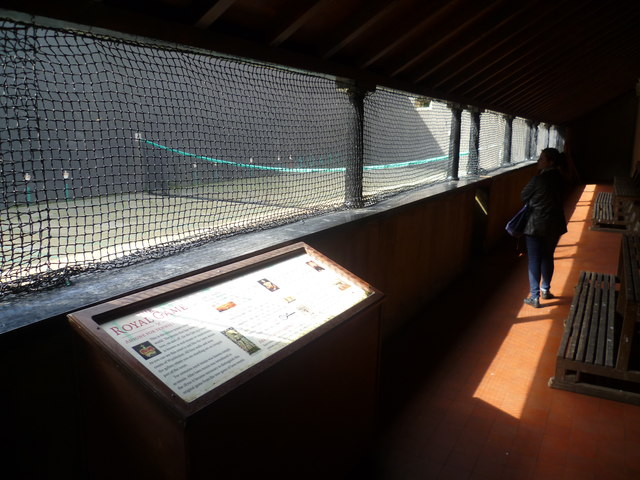
The Real or Royal Tennis Court at Falkland Palace, Scotland.
Perhaps, Americans learned from the British: Wimbledon has become "The Championships", which to me implies that The Australian, French and US Opens are meaningless. The ultimate golf tournament in Britain is just "The Open." Again, does that relegate The Masters to a secondary position? One could argue the Brits were there first. They tend to do this with firsts. I played rugby at Blackheath Rugby Club which was just: The Club. It was the first rugby club and hence called itself simply, The Club.

The British invented the game of golf on a cold, windy heath in Scotland during the reign of James V1 of Scotland, who brought the game to England when he ascended the Southern throne and was crowned James I of England. That was 1603. America was not yet born. Just 200 or so years earlier, Henry V hit a tennis ball for the first time in Falkland Palace. Christopher Columbus hadn't even been born. Yes, the British got there first. I guess they can call their championships what they want since they were the first.

Americans look at the Olympics as our national moment. The Today Show presents daily from the venue. That's how I know the importance of The Olympics. The Olympics are global but are also just once every four years. Americans simply do not play a sport that often for their country. The World Cups in both rugby and soccer (excuse me I meant to say football) are truly global. There are other international events in just those two sports: The Tri-Nations Rugby which pits New Zealand, Australia and South Africa against each other on an annual basis. There is the European Championships in football, again asking numerous European national teams to travel and qualify and then, hopefully, bring back the silver and raise the pride of a nation.

Countries have "friendlies" in many sports including football, rugby, cricket, and more. These countries often call an international match a "Test" match when it is nation versus nation, to differentiate it from a domestic match. We have no such differentiation here in the USA as we really don't require the terms - international matches just do not happen that often.

This experience of playing for or aspiring to play for one's nation is inherent in the upbringing of juniors in nations around the world. It's not in the USA. American juniors look to the NFL or they look to baseball and "The World Series". Neither of these sports are played internationally to any great degree. Baseball is popular in South America and Asia. One could argue basketball is a global sport and they would be right - but there is no Basketball World Cup. Only The Olympics serve in that regard for an international competition on a global scale for the sport.

Being not regulars in this environment, it hurts us as a nation when we play internationally. Our athletes are not used to carrying the weight of the nation on their backs. Just ask Andy Murray how this feels when he plays at Wimbledon. The sport, match and event go past personal ambitions - you are playing for the Stars & Stripes, the glory of America. You might even think you are part of the American Dream and have to prove it to the world. Immense pressure on an athlete that isn't an integral part of our rearing as sportspeople and this hurts performance.

Let's look at The Davis Cup. An annual, international tennis event, which for Americans, allows sportsmen to put their invidual and personal sporting achievements on the back burner and play for their country, their nation, their flag. We learn what it is like to play in a truly hostile environment. We learn, through sport, cultures of other countries. And in the past 20 years as a nation America has suffered in this international event. It's the same for the women too. The U.S. is 0 for 12 in the last 12 Federation Cups. We're suffering on the world stage in sport just as we are flailing in our foreign policy.

Sportscenter or Sportsworld?

As a country in which ESPN's "Sportcenter" tops the ratings, perhaps it is time to look less at ourselves and more at the world in regard to sport. In most nations, one of the highest accolades a sportsperson can receive is to be "capped", meaning that he or she has represented his or her country on a national team. Perhaps if America looks to "cap" more of its athletes in the decades to come, we will understand our foreign counterparts better. Understanding other nations through sport and culture cannot do anything but help our ailing foreign policy.


Saturday, September 15, 2012

Davis Cup: Why America Struggles

Spain Runs Away With Singles Matches

The first two singles matches in this Davis Cup semi-final saw the U.S. drop both of its matches to go down 2-0 in the best of five match. John Isner and Sam Querry both lost here in Gijon, Spain to give the Spaniards the decided advantage. David Ferrer, still tired from a semi-final match in New York on Sunday at The US Open, outlasted Querry in 4 sets and 3 hours. It took 5 sets and and over 4 hours for Spain's Nicolas Almagro to gain the 2-0 match advantage.

Granted that the Americans are missing Mardy Fish who pulled out of the US Open with heart issues and the USA is playing in Spain, but to go down 2-0 so quickly is again another tough day in the history of the Cup for the Americans. In the past 25 years the USA has won the Cup just 5 times. In the last 15 years, the USA has won it just once. Spain has won it 5 times in the past 25 years. Serbia, a country with a population of just 7 million, has won it twice in the last 5 years! And here are the Americans struggling yet again.

This morning the Bryan brothers, who are 20-2 in Davis Cup play, will try to keep the American hopes alive in this semi-final and I am left pondering why as a country the United States has such difficulty in winning this competition. I believe there are several reasons, but two come to mind at the top.

#1 The Play In Spain Stays Mainly On The Clay


The Spaniards excel on red clay, which is the surface of choice for the nation with a population around 50 million. Rafa Nadal has dominated on the red clay of Roland Garros and Rome. The Spanish are dominating here in Parque Hermanos Castro in Gijon on the Northern coast of Spain overlooking the gorgeous Bay of Biscay. It has been a reign close to that of Sweden's when Sweden won 6 Cups in fourteen years. In fact, Sweden is the team with the most Davis Cup match wins since the Cup expanded to The World Group in 1981. The years of Mats Wilander, Stefan Edberg and Mikael Pernfors were a vintage era for Sweden. Borg had put Sweden on the Davis Cup map with an astounding 33 win match streak in Davis Cup play, a record that might never be broken.


Could it be that those countries with juniors that grow up playing the majority of their tennis on red clay have an advantage? It seems so in the past 25 or so years, especially in regard to the Davis Cup. Even those years where the Americans had Pete Sampras and Andre Agassi, the Americans have had a relatively poor showing at the Davis Cup.

In the USA, hard courts are the mainstay of the junior tournaments. Ame rising hopes are hitting balls on the cement or the decoturf in hopes of winning their home title: The US Open. Just as I would argue that the British juniors play much more frequently on grass with aspirations looking at Wimbledon, the Spaniards, and even the Swedes, look at the French Open and red clay is the surface of choice.

Does red clay allow for more stroke production than the hard courts of America or even the green, green grass of Britain? One would have to argue of course it does. As the slowest of the surfaces, juniors are allowed the time to learn proper swing technique with proper form, backswing, and follow through. Just looking at the history of the Davis Cup and the wins, those countries playing on red clay as juniors completely dominate the event. Let's look at it this way: the red clay courts at The French Open's Roland Garros require the ultimate in stroke production from the baseline and a repertoire of shot-making. The last American to win in France? Andre Agassi in 1999. Since the French Open "opened" its doors in 1968, only 3 Americans have won the French title. Michael Chang in 1988, Jim Courier in 1991 and 1992 and Agassi in 1999.

Perhaps with Andy Murray's win on a hard court, the British will realize that looking at the grass is just a small part of preparing a junior for the tour, the Grand Slam, and the Davis Cup. Americans should take note as well and look past just training and playing on hard courts.

In looking at the first two matches of this semi-final in Spain, Isner's 95 unforced errors really was too big a mountain to climb, even with his 24 aces in the match. His opponent, 12th ranked Nicolas Almagro, had just 52 unforced errors in the 5 set marathon. Unforced errors really point at the confidence of a player and his stroke production. Clearly Almagro had the hefty edge in this statistic. Stroke production rears its ugly head yet again. A big serve can get one out of trouble, but it can't win big matches all the time. One needs all the shots on the red clay - the slice, the volley, the swing volley. Sadly, Americans growing up on the hard courts, don't have the opportunity to work on their repertoire as much as nations with juniors growing up on red clay. The pace of the court is just too fast.

Reason number two that America struggles in the Davis Cup will appear in tomorrow's blog, but let's hope that, at least for today, the Bryan brothers keep the American hopes alive and their win avoids a white-washing at the Davis Cup, a world-wide tennis event that Americans should hold dear in their heart. Perhaps the next 20 years will mute my point and see the USA take home Cup after Cup... not likely but we can always hope.