Tuesday, January 22, 2013

Inauguration Day and an Inaugural Run At The Australian Open

New Year's Eve may come and go, but I always get a bounce in my step in mid-January every four years when the USA shows that we can do pomp and circumstance pretty well. We may not have a King or Queen, but we do lay out the red carpet for our president every January 20th.

This inauguration was no different and I watched intently as Barack Obama and the politicos in our nation's capital put on a show. I have to say, Beyonce Knowles has a set of pipes and the arrangement of our anthem, The Star Spangled Banner, was one of the best I have ever heard. If you haven't heard or seen it, here is the performance. Beyonce Knowles National Anthem

That aside, we Americans have some business "down under" in Australia, another "colony" which in fact still has The Queen as Head of State. In a very interesting match, the up and coming American Sloane Stephens, will take on Serena Williams on Wednesday in what might prove to be a match for the memories. The time is coming when Sloane will take over the American baton in this sport's relay and it might be at this tournament that she appears in the theatrical spotlight in this inaugural run in the first major of the year.

Sloane has the power and athleticism to compete with Serena who has been playing some of the best tennis of her career over the past two years. They both have power games and big serves. Stephens at the age of 19 is in her first major quarter final and in the biggest match of her career as of yet against her country woman. Serena and Sloane are friends and practiced together frequently while playing the Federation Cup.

Whereas Serena is playing through her matches quite easily, Sloane had some tough struggles to get to this point in the tournament and this may in fact serve her well as she has been tried and tested in the Melbourne stadium. Serena has not been and nerves will play a role here for sure.

She may not win her first quarter final tomorrow, and in fact Vegas has Serena as a heavy favorite, but I think Sloane's time is here and she will take that baton from Serena soon enough and it may be as early as 2013. I'll be tuning in late night.

Tuesday, January 1, 2013

Yemassee and a New Year

I have been thinking of this post and rewriting it as it has nothing to do really in regards to tennis. But as we turn the leaf over into 2013 it is always a good time to reflect.


One of the benefits in being a "seasonal" teaching tennis professional is that I get close to 4 months off a year. I enjoy this time with my family and I get some father/daughter bonding time before and after my 3 months working in Martha's Vineyard in the summer.

It's always tough to leave the family for an extended period of time. I had to travel to Singapore and Australia in my prior work leaving my wife back in the UK alone for up to a month at a time. But 12 weeks is a long time to be gone from one's home and family. My answer is: "Our American soldiers go farther away for a longer period of time and are doing jobs that endanger their lives on a daily basis." I am very lucky to be able to lead a life teaching tennis.

I do get to travel with tennis and I drive up and down the East Coast and once in a while I find a place that makes me realize how big a country we are and just how many cultures we have here in the USA. But then again, no matter where we are, we all have the same goals and objectives in life. One stop I made on my a recent migration was Yemassee, South Carolina.

I was on the hunt for gas as I had allowed the small gas tank light to come on and I had travelled off the beaten path this one morning of my journey. I had left behind most of South Carolina's back roads and was on Highway 17A when my tires rolled into Yemassee, South Carolina.


A town of approximately 1,000 people, Yemassee boasts one gas station that I could find: El Cheapo Gas.

Yemassee was the center of the Yamassee tribe of Indians up until the Yamassee war of 1715. Few towns boast a whole war with the town's name. As I drove down into the village, I noted Civil War encampments and fortifications by the roadside and I realized I was in the heart of a town that had a big Civil War history. In fact, all of the churches in town were burned during the Civil War except the Presbyterian Church which served as an army hospital for the Union soldiers.

The railroad passes through Yemassee and I learned that over 500,000 troops travelled through the Yemassee depot on their way to Parris Island and training just 45 minutes away. Yemassee has seen war and its ramifications in many ways over 2 centuries.

It's amazing to think, as you drive into what seems a small paradise, that the past and the events of war is never far away. Will 2013 see peace and prosperity? For those 1,000 people in Yemassee in their South Carolina small town through which AMTRAK rumbles through twice daily, life is no different than those of us in bustling South Florida and our 6 lane I-95 just 400 miles or so South. Cultures may vary and accents may have different twangs but we worry about peace, we tend to our families and friends and we live with our faults and strengths, our memories and our future, of which 2013 is just a stepping stone.

Sunday, December 9, 2012

30 Years On And We Still Miss Him: John McEnroe & The Complete Player

I was having dinner with my sister last week and she was asking for events that had happened exactly 30 years ago in the tennis and golf sphere as we are both employed in the country club industry. So, where else to start but type into Google: Wimbledon winners, 1983


John McEnroe defeated New Zealander Chris Lewis. Remember Chris? I didn't. He beat one of my favorite players South African Kevin Curren in the semi final. Lewis was only the second New Zealander to ever make a final and was unseeded. McEnroe ended Ivan Lendl's tournament in straight sets in the other semi-final. Tougher match for sure.

It was a good year at Wimbledon. But what I noted was who won the doubles: John McEnroe and Peter Fleming defeated the American brothers Gullikson. Guess what? Big Mac did the same thing in 1984 taking home the singles title after beating Jimmy Connors in the final. McEnroe and Fleming again won the doubles against Australians Pat Cash and Paul McNamee. That's four Wimbledon titles in 2 years. I didn't look at mixed. The story was there. On the men's side McEnroe and Fleming were just complete players. At the same time, Martina Navratilova and Pam Shriver were doing similar things on the women's side. They just don't make tennis players this complete anymore. When was the last time, I asked, that the men's singles player also won the men's doubles title at Wimbledon? You guessed it. John McEnroe.

Perhaps it's me looking back at the history of the game I love with rose-tinted glasses - I actually wear contacts now for those high school friends who read my ramblings. Perhaps I am not giving enough credit to the players of today - Serena and Venus play the singles and doubles at most of the major events. But they just don't play that many events.

Fleming and McEnroe won four doubles titles at Wimbledon and three at the US Open. All the while Fleming maintained a top-ten singles ranking and McEnroe stayed either at the top of the rankings or in the top three. We wonder why McEnroe is such a great commentator - he was not only a fantastic player, but perhaps one of the most complete players we have ever seen.

If you look back at his time on the tour, McEnroe may be remembered for his behavior, but in reality we should remember him for his fabulous, yet unconventional serve, his simple and effective groundstrokes and his amazing hands while volleying at the net.

To look closely at his forehand, it's so simple and relies on his great eye-hand coordination rather than power. He forfeits any type of a loop backswing, taking the racquet directly back to the low position before he comes up to meet the ball rather flatly, using the pace of his opponent in most cases to hit back with speed. Have a look here:
Perhaps you could out finesse the Big Mac and not allow him to use his power? Only one player was able to do this: Guillermo Vilas who won more matches then he lost against the Big Mac.Vilas was another great who is largely overlooked. He won seven, yes seven, consecutive titles, following Wimbledon right through and past the US Open. Most players today don't play seven tournaments in a similar 8 to 9-week period. Oh, Vilas played doubles too. This was the era of the complete player - on any surface and in singles and doubles and at the baseline and at the net.

This match, against Stefan Edberg, perhaps proves the finesse and yet, the power too with picking winners cross court and down the line by both players. Look at how both exploited the weakness of their opponent and used their own strengths to create and build a point.


The legacy of McEnroe is enormous as we think of his serve and volley game combined with fabulously simple ground strokes. McEnroe remains perhaps the leading example of the complete player and perhaps that is why we either love him or despise him as a commentator. He is perhaps the greatest tennis commentator of our time for the BBC in Britain and back here in the USA with insightful tips and great understanding of the minutiae of a match or point.

When asked to perform an impersonation, Novak Djokovic often mimics Johnny Mac and his unorthodox serve. Djokovic's imitation alone proves just what an icon McEnroe was in his time because in 1983, thirty years ago, Djokovic wasn't even around yet.

Wednesday, November 14, 2012

A Fitting Finale in London: Djokovic versus Federer

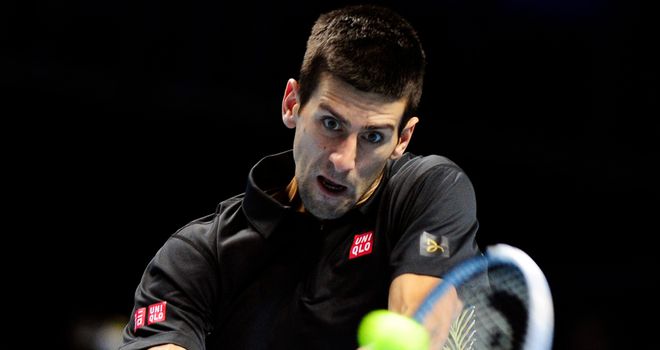
It's a bit like how the season has gone for these two - close and closer and closest. It may not be a year for either Djokovic or Federer to remember and put at the top of their resumes, but the two giants of the ATP Tour really treated us to a finale yesterday in London's O2 Center which was tennis at its best. Each had won a Grand Slam this year, Djokovic winning in Australia and Federer taking another title at Wimbledon. So this match was going to settle the score at the end of the season.


Think about this: Federer didn't lose a point to the Number One player in the world until the third game. And that said, Federer was already 25% of the way to the final destination, a win, within 9 minutes and up 3-0. But like a horserace, there is no clock and Djokovic started to chip away and get the older Federer into longer and longer rallies, which favored the 25 year-old Djokovic. Before you could blink, Djokovic was winning the first set in a tiebreak and went on to win the match in two straight sets.

This was the second time in two days that Djokovic had come back from what looked like a losing proposition. The previous day, Juan Martin Del Potro had Djokovic on the ropes yet again. Djokovic, losing the tempo on his serve, was watching the 6 foot 6 inch Del Potro move well within the baseline and take the second serve waist high. Djokovic lost the first set without much of a whimper. It looked again like Djokovic was going to be beaten badly... and yet, he came through the 3-set match a winner.

It really showed here at the end of the season what we knew at the beginning of the season when Djokovic beat Nadal in that 5 hour 53 minute epic in The Australian Open final: No one can actually outhit Djokovic over an entire match. There might be spells and games where one can push him back, but over the course of three or five sets, Djokovic's groundstrokes will outlast his opponents if his mental state remains sober and focussed.


Sunday, October 21, 2012

To String Or Not To String: That Is The Question

This is probably the question I am asked the most at this time of year. Between summer and winter seasons, we as players are left to ponder how strings and tension might be affecting our game. The debate is continually ongoing and there is never a right or a wrong answer.
The general rule of thumb is to restring your racquet each year the number of times you play in a week. If you play three times a week, the general rule would therefore be to restring your racquet three times. But even this general rule doesn't always work or make sense in relation to one's game.

So, you ask, what is appropriate?

To discuss the professionals, the trend has been to lower the string tension. Back in the day of Jimmy Connors or Pete Sampras, the tension would have been up near or even above 70 lbs. But nowadays, the tensions have been coming down. With powerful new racquets, there is no need to string as high as we once did. For example, the professionals probably use a new string job for just a set, if that. They may change more frequently. They have professional stringers on site to manage their many racquets and use string that is not always conducive to a game at club level. Strings deaden quickly at such a pace and frequency of hits. But what about us mere mortals on the court? How do we know when our strings are dead?

The number one priority in stringing for play at any level is the actual "playability" of your strings in conjunction with your game. Too often we look at what others are doing or what the professionals are doing in terms of string and tension, but that might not suit your own, personal game. 

If you hit with more topspin, you might look to restring a bit more as the strings become frayed as there is more gripping of the string required as it makes contact with the ball on each stroke. The more you hit low to high, the longer the ball remains on the strings. Oftentimes, customers come up to me and say, my strings are done - they are moving. Well strings do move and the pattern will change shape if you are hitting with a good amount of topspin. If you hit flat, you may get away with fewer restringings as the string stays intact longer as the ball is not on the strings for as long a period.

Different types of strings have various stretching tendencies. The popular Sensation or NXT from Wilson Tennis stretch a lot more than Wilson's Luxilon string, which is more wire-like. Strings that stretch offer more control but need to be replaced more often 

The answer to whether you should restring is a personal one based on use and type of string and how your game is progressing. The best way forward is to ensure that you feel comfortable with the strings in your racquet. If not, change them out and restring or test something new with a demo of your own racquet strung differently. But by lowering or raising your tension or changing string it's a whole new game. It's trial by play!

Sunday, September 30, 2012

The Ryder Cup

There's something about golf that's different this week. Golf has become one of the leading televised sports and week in, week out the PGA puts on a show. Sunday evenings find many millions of Americans, and foreigners too, huddled in the family room watching the sun set on another PGA event - will Rory McIlroy stay ahead or will one of the pack come up and take the trophy. From Congressional to The Masters, from Oakmont to The Fed Ex Cup - golf delays 60 Minutes here on the East Coast almost every week.

But it was interesting to hear this week the first time golf delayed 60 Minutes. In a recap of the 1991 Ryder Cup at Kiawah Island Golf Club in South Carolna, one of the PGA executives mentioned that network television stayed with the Cup coverage and delayed the network's programming for "The War On The Shore" as that year's Cup became known as it went down in lore as one of the greatest ever Ryder Cups.

What makes the Ryder Cup so enticing? Why was it that network TV decided to keep the cameras rolling? Why is it that I remember watching The Ryder Cup more than I do Wimbledon with my British friends during my years abroad?

Two reasons. First, The Ryder Cup is one of those rare times when professionals play for country rather than themselves. There is a higher desire, a greater good, a mightier meaning. It's so rare that the USA gets behind a team internationally. But The Ryder Cup is every two years on opposing sides of the foaming Atlantic. It's an international event and shows just how different the same game can be on different sides of an ocean. Churchill once said that Britian and America are two nations separated by a common language. We are also two countries, and now add Europe to the mix, separated by a common game: Golf. Deep down we know Tiger Woods doesn't enjoy playing a links course. And the Brits and Europeans just don't really understand Bermuda grass, the grass on most American putting greens.

This year at Medinah Country Club outside Chicago, Davis Love III, the American captain, has asked that the fairways be widened for his big hitters like Tiger Woods and Keegan Bradley. There's very little thick rough. The weather has been friendly with not much of a breeze with cool Autumn sunny days. You can wager that in 2014 at Gleneagles, nestled between Dundee and Loch Lomond north of Edinburgh, the wind will be whipping, the temperatures will be colder, and the rough will be thicker.

The second reason we love to watch the Ryder Cup is that the format is, well, just perfect. With professionals playing what we amateurs play every Tuesday morning while we skive off work, The Ryder Cup offers us, the viewers, a format we can relate to. It also puts the professionals playing against each other right in the same foursome - right there to stare down each other with a poker face while supposedly studying one's yardage notebook. The morning is a two-ball, alternate shot format, so different from the stroke play we see each week. The afternoon is a four-ball. Enemies on the tour are hamming and egging to win a point for their nation. What a change. It's a lot more like the Texas scrambles I like to play against my father's friends when I am home for the weekend. The only difference being there's no math at the end of each hole to figure out the handicaps with these guys at Medinah. If you're in the hole in 4, you're in the hole in 4. Oh yeah, one other difference: The shotmaking.

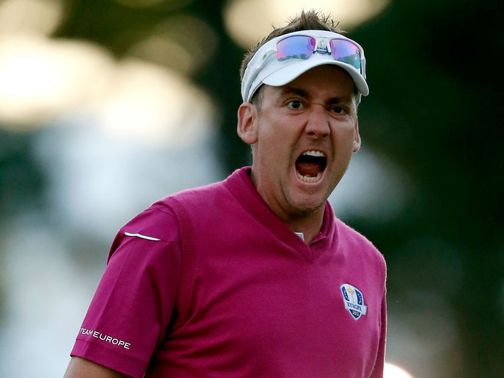
Ian Poulter reacting to abirdie putt.
Match play simply makes the opportunity for great shot making. Like Ian Poulter hitting inside Zach Johnson on the par 3's to within 4 feet, or draining 5 birdie putts on the last 5 holes to keep the European hopes alive. Match play allows Phil Mickelson and Keegan Bradley to become an unlikely American wrecking ball, putting away their opposition with shot after shot - face to face, tee to green. You can't play for the next hole when each hole counts and your opponent is 6 feet and pin high. Time to stop playing for the center of the green and two putt.


Perhaps it's that the Tiger has yet to win a point that shows just how different match play is. He and Steve Stricker have gone winless the first two days and Woods is the last match out on the course today in the singles competition. Did captain Love put him there to keep Woods out of the match? We'll never know. Woods probably won't have a part to play in today's finish. The Ryder Cup, with the USA holding a large lead, will most likely be over before Tiger makes the turn. But, if like in 1999, the Europeans make a comeback from a similar deficit, we'll all be watching Tiger as the anchorman against Francesco Molinari, number 31 in the world. It's a bit like Roger Federer playing Viktor Troicki. Who, you ask?

Yes, who. That's the beauty of match play, golf and the Ryder Cup. Each singular, graceful, green, different golf hole represents another chance to beat the guy walking with you, not just winning for you, but for your country. 18 pins flapping this morning in the slight breeze at Medinah. 18 chances to win it. 18 holes of glory.

Friday, September 28, 2012

Federer, Djokovic and Nadal - They All Tap The Dog

Good Doggie!

So, what is it that all three of the top players in the world have in common on their forehand? They all "tap the dog."

In learning from one of the leading teachers and academy owners, Rick Macci, here in Florida, he took me through how similar the stroke of Roger Federer, Rafael Nadal and Novak Djokovic are. He calls it "tapping the dog" and I will explain what he means by that.

If you look at the forehand video of Roger Federer in the previous post below, the "tap the dog" position comes at 11 seconds into the video - racquet strings closed to the ground and his elbow creating space between his elbow and rib cage. Imagine if he dropped his racquet, opened his palm, and tapped a dog on the forehead - that's the position.

This position is quite interesting in fact. The elbow is away from the body. Many students of mine ask if the elbow should be in tight or away from the body as the racquet comes down out of the higher part of the loop. Away from the body is the answer for these three players - Nadal possessing the most compact swing his elbow does not leave much space until he starts his forward progression.

Big Players Don't Push... They Pull!

But what is even more interesting to note is that each player literally pulls his racquet hand forward - think of a pulling action forward across the middle of the body. This action pushes the racquet "inward" from the "outward" position where it lies when they "tap the dog". So these three players are not laying the racquet back inside and back to where it points to the back screen - the racquet is pushed there by the force from the "pull" forward of the racquet hand toward the ball. Their motion forward is a lot earlier than us mere mortals and because of that the racquet moves backward and inward even as their hitting hand is moving forward toward the ball.

This pulling action is quite evident between seconds 4 and 5 (0.04 to 0.05) on the Djokovic forehand video and at 0.10 on the Nadal video. In fact Nadal's racquet is already quite close to perpendicular to the back screen and it moves way inside behind him prior to moving forward toward the ball, even though he has pulled his hand quite forward already.

But in my book, Roger Federer has the most classic forehand in this regard. His "tapping the dog" position is nicely away from his body and the strings are almost fully closed. As he comes through the swing, he pulls his hand through around 0.14 to 0.15 and you can see how the racquet head reacts and comes back inside toward the back screen and bit toward his back hip prior to moving forward. Look at how early his hand is in comparison to his racquet. His hips are already rotating at 0.15 and not until 0.19 does he make contact.

I know it's slow motion, but he's so early and the racquet speed at contact is so fast, the racquet comes and catches the hand to be parallel with his hitting hand at contact. The hand had been leading the swing the entire time! But the racquet's speed at the end of the swing is too fast and catches up with the hand and then bypasses the hand into the follow through.Guess that's one of the reason he's won more Grand Slams than anyone else alive.