Sunday, September 13, 2015

She Sliced and Diced and Mentally Overpowered A Champion

Novak and Roger may play tonight, but the real story at this year's US Open is Roberta Vinci and her defeat of Serena Williams. Williams lost in the semi-final to Vinci, known more as an Italian doubles player, and fell short of a calendar grand slam.


Roberta Vinci. Unseeded. Ranked outside the top 40 in the world. Vinci may have lost in the final, but she showed how you beat a champion and a bully. She held her hand up and asked the champion to wait. She turned her back to the vocal shouting. She didn't break down when Serena yelled across the net. The Italian doubles specialist was first to her chair on the changeovers covering her head with her towel. And she hits a slice, one-handed backhand with very little pace and proved that slicing and dicing takes no prisoners.


Rarely in her career have we seen Serena hit a slice backhand, or a forehand for that matter, but this world number one doubles player from Italy forced one of the greatest players of all time to change her game. There wasn't much pace coming from Vinci's side of the court. Brad Gilbert calls her "DaVinci" and she lived up to that name as she sliced, diced, angled and artistically stroked her way to a victory ending a Grand Slam run - a feat only completed by three women previously and just one in the Open Era.

But Vinci changed the mental game as well for the first time ever on this American champion. She won over the New York crowd. Vinci stayed the course. As the match hit two hours, Serena tired but grew vocally louder. Every winner with punctuated with a screaming exclamation point. Vinci took no notice. She's 32 years old - no intimidation here. She's seen it all before. Vinci tossed and served and didn't take note of Serena showing her Nike's dress back straps as she tried to hold up Vinci's march to dominance. Vinci held her hand up when the Champion was ready to serve saying: "Just wait a moment - you make me wait on my serve? I'm gonna make you wait on yours." This Italian was not going to cower. She owned the court. She owned the crowd. And, she won.

The tennis was not stellar. Vinci took Williams out of her comfort zone, with drop shots, sliced backhands and approach shots, volleys and dozens upon dozens of lobs. Serena rarely sees a one-handed backhand - there are only 2 one-handed backhands in the top 100 women in the world. But what we forget is that a one-handed backhand hits the ball much earlier than a two-handed backhand. Serena wasn't prepared for the earlier contact of the ball - the Champion was on her back foot continually even on her masterful forehand. Serena hasn't seen slice like this in years. And she hasn't seen an opponent mentally as strong as Vinci was on this day since Sam Stosur defeated her on the same court in 2011.

Roberta Vinci may have ended a Grand Slam run, but she probably brought tennis back to a reality with a win reminiscent of a McEnroe, Edberg or even a Nastase. Let's see if Roger moves up to the service line on Novak's serve and plays more like a doubles player, reminiscent  of a Bob Lutz or a Stan Smith... or even an Italian doubles player named Roberta Vinci.

Sunday, January 25, 2015

Coach K Hits 1,000 Wins

Dear All Who Aspire To Be The Best:

Dressed in a suit with sneakers replacing his loafers of 35 years on the floor, a man today reached a milestone at Madison Square Garden that has never been reached before. With grit and wit, class, finesse and grace, a giant of his sport, if not an icon of sports, surpassed 1,000 wins as a Division I coach.

Maybe Duke's Athletic Director Tom Butters knew what he was getting when he hired this coach from Army back in 1980. But, I don't think Butters ever envisioned this. Three poor seasons at Duke at the beginning - Butters had the fortitude to stand fast and it paid off.

This coach now defines college basketball in every way. He has coached the best of the best in college basketball and all those players are a part of this phenomenal record. Congratulations to you all.

He's been through it all. He's been through the NCAA wringer and the wrath of the media while heading a team and program that is loathed by most of America. A small private school in the heart of tobacco country full of "trust fund kids with BMW's". Duke wasn't known for its basketball - well that was until he showed up.

He has coached through "Lacrosse-Gate" where Duke hung three lacrosse players out to dry and the reverberations cost the District Attorney his job and the lacrosse team a chance at a national title. All through this, basketball has remained at the top of the national polls.

Not many people surpass their idols. He passed Bob Knight a while back.

He has recruited through the Iraq war, 911, player injuries, NCAA inquiries, ACC reorganizations, personal back pain, and today's "one and done."He's won Olympic Gold while managing Team USA through the professional era. Who says you can't coach college and professional at the same time?

The legacy he leaves behind is already bright. So many of his players are a part of the sport from playing to coaching through to sportscasting and scouting. His career is unrivaled. He has appeared in 19 consecutive NCAA tournaments. 12 ACC regular season championships. 11 Final Fours. You name it, he has done it.

And now he has done this. 1,000 wins. Well done Michael Williams Kryzewski. I liked you way back in the late 90s when you won your first championship in Indianapolis.
I revere you now.

Tuesday, December 9, 2014

Doubles Strategy - Thirds Of The Court - Play Hockey Goalie at the "T"

Everything in life seems to be able to be broken down into statistics or rules or a theory. While grinding out my Sea Captain's license I learned the rule of sixths - there are 6 hours in each tide, with the most water running in and out of the tidal basins during hours two, three and four. In music, you have the circle of 5ths... a geometric relationship between the chord structures and harmonies in Western music. We all know the law of diminishing returns, and let's hope that does not pertain to our tennis games!

The Rule Of Thirds

In doubles, there is a rule which every player, from beginner to advanced, should know. The Rule of Thirds. When playing doubles, one should divide the court into thirds and cover the court in accordance with these thirds. Basically leave uncovered the third of the rectangle on your side farthest away from the ball being played by your opponents.


The red lines above delineate the court into thirds essentially. For an example, let's just say you are returning the serve and hitting the return from the "A" position and that you hit cross court back to the space where the "Player" is now hitting the ball. In effect, how would you shift to cover this wide ball? Well your partner who had been at the hotseat would hopefully close toward the net and follow the ball into the third of the court to the left and take a position close to where it is marked "C". But here's where most of us make our error.

From position "A" the returner should really move into position "B", slightly staggered in order to cover the lob. But also, really straddling the center service line. Why? Because the center service line marks the center of the middle third of the court. So, you and your partner are clearly covering the 2 thirds of the court closest to the ball being played. You cannot cover the entire rectangle that is your half of the court, so you leave the third farthest from the ball -('A') effectively uncovered - it is the hardest shot to hit for your opponent.

Where we make our mistake is not covering the alley when we are moving to the far third to position "C" - we usually do get there. Where we make out mistake is not straddling the center line and covering the "T" - where the center and service lines meet - like a goal keeper as most balls returned are going to cross that area. We have to move from "A" to "B" quickly and decisively.

By covering the two closest thirds of the court to the ball, we are in essence taking the easiest shot away from our opponents but also moving the "center" of the court to the left. The seam between us as a pair has shifted left and that is why it is essential to really straddle the center line to cover a shot that actually follows the red line through the court which is the seam between positions B and C at this point.

"But Coach, what about the uncovered third?" Well, in reality, you have most of it covered. A cross court lob deep to that third is the longest path for the ball to travel and the player in Position "B" can easily cover it given all that time. And... if the player at the "B" Position moves forward and cuts off an angled return headed toward the alley, only the alley closest to the net is completely uncovered. If your opponent makes the shot, give them a hand. It will be a rare occurrence. Good Luck!

Sunday, September 7, 2014

A Changing of the Guard at the US Open

Mark it down in your history calendar in our wonderful sport of tennis. Saturday, September 6th, 2014. The day the reign of the Big 4 ended.

The Big 4 alludes to men's tennis and to Novak Djokovic, Rafael Nadal, Andy Murray, and lastly, Roger Federer with his 17 Grand Slam single titles. These four players have won 36 of the 38 most recent Grand Slam titles. On Monday, that stat will be 36 of the last 39. None of the above is in the US Open final.

And yesterday, two of the Big 4 were just plain beaten. Djokovic was simply outplayed on a day where he may have not been at his best wilting in the heat of 90 degrees plus on Arthur Ashe stadium court. Kei Nishikori, the first Japanese player to ever reach a Grand Slam final, with an added day of rest wore Djokovic down over four sets.

Federer couldn't deal with Marin Cilic's serve. In fact, the last game provided the epitaph to the grave: Three aces and a backhand winner down the line. Done.We are left wondering how long Roger will stave off the desire to retire.

So we are left with a final in which CBS Sports loses its coverage of the US Open after 40 plus years and in which, I am sure, ratings will falter without one of the Big 4 playing. But, this is the Open Era, and anything can happen. ESPN takes over coverage of both Wimbledon and the US Open in a tumultuous time in Men's Tennis in which are there are no clear rivalries to market to the public or elder statesmen to revere. It could hinder the growth and popularity of the sport.

That being said, it will be great to see new faces in the final and to see how Nishikori deals with Marin Cilic's serve will be interesting. Nishikori has won his last three matches against top 6 rated players in the world. He is the real deal. Coached by one of the greatest returners of all time, Michael Chang, Nishikori will undoubtedly find a way through the Cilic serve.

Cilic, at 25, is coached by the big server Goran Ivanisevic, himself a Wimbledon champion who also won on a Monday in front of a raucous crowd against a confident Patrick Rafter in the final. Cilic, suspended from the tour last year for a positive test to a banned substance, has returned mentally stronger and playing some of his best tennis.

Back to regularly scheduled programming with Serena Williams today in the women's final. And, Monday night should be a wonderful match between two upstarts who have been waiting a few years on the bench.

Wednesday, May 28, 2014

The Greatest Player Of All Time... In My Book

So, over the past three months since I put this question out there, I have had people stop me, Facebook me, and write to me with their nominations. I list a few below and the validity of these nominations are truly excellent.

Jimmy's matches were always something special!


Jimmy Connors - Did you see the ESPN movie about the 1991 US Open in which Connors at the age of 39 defied the experts and beat Aaron Krickstein in probably the best remembered match ever in US Open history? Someone asked me this just recently. It changed Krickstein's career forever and was perhaps the greatest match of all time. I was outside the stadium in Flushing Meadows and hearing the electricity in the crowd was unreal. But one match and a comeback at 39 does not make Jimmy the greatest player of all time.


Martina Navratilova some of you have said. She's right there. What a player - going for broke and changing the way women played our lovely game by approaching and coming to net. One of the matches I remember most as a young player was the US Open final in which Martina lost - to Hana Mandlikova. Probably the greatest women's match ever played. But Martina's story behind her tennis is simply amazing. Leaving her communist heritage, moving to the States, breaking the homosexuality border in our sport. We have her to thank for a lot in our sport and in our world. Her persona is one of the biggest in sport. All this while winning 59 Grand Slam titles. Are you kidding me? Oh yes, and 18 singles grand slam titles - that's one more than Big Rog folks.

Oh but wait, Chris Evert has 18 Grand Slam titles as well. Can we include her in the conversation. You sure can. But, for me, she's not the greatest to ever pick up a racquet. She was a grinder from the baseline who outlasted opponents rather than beat them. But, she was a fierce competitor and a truly great champion.

Pistol Pete Sampras - Perhaps the most efficient player ever to play tennis and having just been surpassed by Roger Federer regarding Grand Slam singles titles ever, he is up there in my book too. His rivalry with Andre Agassi was one of the greatest in the history of all of sport. I can remember watching Pete win Wimbledon during my college years and just amazed at how he changed his entire game to win that coveted title.

This is a never-ending debate and I have thought long and hard about it as naming the greatest person to ever hit a ball in your sport is actually quite terrifying in a way!

So who's left?

You've probably guessed it. Serena Williams.

Best Player Ever...In My Book.


Serena has, like Martina before her, simply changed the game of women's tennis. Singlehandedly. We had all heard back in 1996 and 1997 that the younger Williams sister was going to be the better player but, rightfully, many questioned her stamina and desire to win at that young age. Would she live up to the hype and the reputation she was assuming? A big assumption.

She did and she continues to do so. Ok, so she's only 7th on the all-time Grand Slam honor roll with 32 titles to her credit. She's tied with "Fed" at 17 singles titles. I do think she has a few more singles wins in her. But, in this era of open tennis with massive qualifying events, the growth of the WTA over the past 20 years, and tennis rising once again to be one of the most popular sports in the USA and the world, Serena has been at the top of her profession since she turned professional at 14. And honestly, I don't see her grip of the "racket" sliding much. In fact, 2013 was probably her best year ever.

But in reality, her grip should be sliding. Let's put it this way. She won her first professional title in 1998, five years before Roger won his first. She's 32, same as Roger. He's spent more time at the number one spot, true. So has Steffi, Martina Navratilova, Evert, and Martina Hingis. But none of them took years off to fight injury or depression after the murder of a sister. In fact, after her break from tennis and restarting in 2011 after a pulmonary scare, she is 158 wins with 11 losses.

But Serena, and partly her sister Venus, have changed the face of tennis. One-third of all new junior players are either African-American or Hispanic. Television ratings for Serena are some of the highest ratings any sport has ever seen, including American football.

Serena, like Navratilova, had her own demons to overcome. Fighting racial hatred among the predominantly white juniors on the USTA junior tour while living in California and Florida, Serena also fought with her emotions. Personally, I am not a big fan of her personality, but how can you deny she's one of the fiercest competitors to ever take the stage on a stadium court - male or female.

But the main reason for Serena being the best that ever played? Well it's just that. When she is at the top of her game, she simply is untouchable and unbeatable. No one comes close. There is no one who can even come close. Her serve is up there with most male players at 125 miles per hour. Sharapova, Clisters, Henin, Capariati - all of her rivals pale in comparison. Sharapova, for all the love we have of her and how we think she is great, has just won one set since 2008 against Serena. Since 2004 Sharapova has this hallowed record against Serena. 1 win, 14 losses. Hello?

For Serena to be this dominant in a sport (even with her loss yesterday at The French Open) and with all that she has gone through... to accomplish her goals and be the highest paid sports woman in history... in all of sport...it just makes her the greatest all round player of all time.

This week in Paris will be interesting in that if both Venus and Serena win another round, they will have to play each other on the red clay of Roland Garros. Well, my pick will be Serena. But, Venus might have something to say. She has the best record against Serena although it's not a winning record. But I think little sis is just too good.

Monday, May 5, 2014

Racism, Donald Sterling and a Zero Sum Game

It's been a bad week for race relations in the NBA. With the country focussed on a recording of LA Clipper owner Donald Sterling, the NBA Commissioner, Adam Silver, came down hard on the owner meting out a $2.5 million fine along with a ban for life for Donald Sterling.

Much has been said about this iconic, yet racist, tactless, and repugnant owner. Sterling, in fact, is the longest tenured owner within the NBA. Sports writer Bomani Jones eloquently went on the record asking why the NBA hadn't looked into his past racist behavior prior to this recording? He had been continuously fingered for racist behavior, business practices, and speech. Why only now should the NBA act? Jones is right in his thoughts and words.

The additional idea put forth at the news conference was that the Board Of Governors of the NBA, which is comprised of the 30 team owners, is that Sterling be forced to sell his team under the authority of the Board of Governors. This is where the sentiment of "doing the right thing" in terms of rebuilding race relations and interfering with business and property start to cross lines and make issues quite messy. Owner of the Dallas Maverick's Mark Cuban has put it that interfering with such business by the NBA is the beginning of "a very slippery slope." And he might be right.

Granted that in this day and age of phones, Twitter and Facebook, the world can literally hang on any syllable of any given individual, we are left wondering how we as a society can make better our environment as a business person or, even as a citizen of this world, with so many obstacles. Once an association we are a part of comes down against us and forces us to part with property that is our business, where do we draw the line? A home owner's association putting a lien on a home for example if not adhering to code comes to mind. Does the association force a sale? Does the National Basketball Association force an involuntary sale of one of the most profitable franchises now?

We as a society want to punish those who hurt race relations or the advancement of our country at its core. But in so doing, we might be hurting others that we do not realize. For within California's tax code 1033, there is a provision that says if property is taken away by force (eminent domain and involuntary conversion, for example) there are no taxes payable. As Nick Lum of the Daily Beast writes, the NBA forcing Sterling to sell will create a $200 million shortfall in tax revenue to the US Treasury and $123 in tax revenues for California - a state that sorely needs it. Basically, if the NBA forces a sale of the LA Clippers, they could be saving Sterling $323 million.

Life seems to be a zero sum game and it's no different in sports or business. The question that is out there is where do we, as a society, draw the line between condemnation and punishment. It will forever be a question without a black and white answer.

Thursday, November 14, 2013

The NFL Comes To Grips With Human Resources and Not Being Incognito

Last year, The NFL and Roger Goodell had their hands full with the pay dispute over the referees. We, as viewers and players, were happy to see the referees return to the field and bring the season back to normality. Big business always has labor disputes - it's part of the territory. Big business also has Human Resource issues and none bigger than what is transpiring in Miami.


I sit in bewilderment when I hear people and pundits on radio and television say - along with fellow NFL players - that there is an attitude one has to bring to the game of football. I heard something akin to this: To play football professionally, you really have to have an attitude that other people or athletes just don't have or understand. Well quite frankly, I couldn't disagree more on two separate fronts.

On the sport front, it really is a ridiculous statement. Football players are no grittier than rugby or ice hockey players or race car drivers who dash from death weekly on the Nascar or Grand Prix tours. Having played both rugby and football myself, I found rugby ten times more grueling without having any stoppage in play, having to play offense and defense, and hitting just as hard all without any padding or head protection. Rugby players rarely question the referee - they play a mean game with tact, sportsmanship and brutality. I am sure hockey players would say their game is brutal too. To sail around the world solo is grittier than I can imagine.To play 162 games in one season, as major league baseball professionals do, is unrivaled. Night after night, traveling and playing and then traveling again. Brutal on the mind and body. The NFL, folks, is just another game and sport.

But more importantly, we are all football players. We, as Americans, work to provide for our family and maintain an economy in a moral-based environment and country. And there is never an excuse to racially slur or humiliate a fellow worker. It's a sad day to see a team effort debased by offensive behavior.

Football is one of America's biggest exports in reality with games now watched across the globe. It's big business. And this "attitude" that one has to bring is brought into a significant workplace - the locker room and on the field. NFL players are employees and are paid to perform. They cannot make the workplace hostile to fellow colleagues, players or coaches. If they do, they should be dismissed like any other employee. NFL players are just like the rest of us workers: working hard in a stressful environment. No different. No one should ever use the "N" word, as a person or an employee. Nor should any football player at any time for any reason. Neither can Richard Incognito. To even start defending him is callous and wrong.

This is a human resources issue which could lead to criminal charges, and the NFL needs to get on board and stamp on this harder than they are stamping down on helmet to helmet hits. How can we improve our own workplaces here in our cubicles or are classrooms when our "idols" in the NFL are using the "N" word? We can't. We have to show the world how wrong this is and in order to do that Incognito must become incognito - terminated by the Dolphins and banned from the NFL without severance or benefits and without a glowing reference. Anyone in any other office environment or workplace would be treated, hopefully, in the same way. The NFL is no different and they had better understand that point sooner rather than later.


Saturday, October 5, 2013

Don't Burn Your Bridges... In Golf, In Sport, or in Life.

As I watch the drama of the President's Cup unfold, I am reminded as Tiger Woods plays with Adam Scott that Burning Your Bridges is never a good idea in life or in sport.


By Burning One's Bridges, which is an idiom of course of American English, we really mean more than just disliking someone or something. Burning Your Bridges, really comes from the military and the strategy in which one army would burn the bridge or bridges to prevent the pursuing army from chasing. However, what about being outflanked?

That's what happens in life. Being outflanked. It happens in sports too. It happened when Steve Williams started bad-mouthing his former employer, Tiger Woods, in 2011. We were led to assume that Williams was fired for working with Adam Scott while Woods was injured. But there were deeper secrets than that and Williams learned quickly how the media can turn a jest or a joke into a context about a former employer. And when Scott won his first tournament with Williams as his caddie, Scott retorted that it was the pinnacle of his career as a caddie - debasing the years he had worked with Woods and won so many titles. Williams was quoted saying to David Feherty of CBS: "I’ve caddied for 33 years — 145 wins now — and that’s the best win I’ve ever had."

That's Burning Your Bridges...

It's taken more than two years to build the bridge between Woods and Williams. Williams actually has gotten off pretty lucky. His employer, Adam, has been top three in the world for the majority of the past few months and Tiger, forced to take the high road anyhow following his own scandal, really didn't say much in retaliation.

But think about where these two might be without two years in the doldrums. That's why it's hard to retreat once you've Burned That Bridge. No tension would have ensued. Perhaps Tiger would have played better and Williams' book might have sold better. One doesn't know.

So, today was refreshing not for Tiger's win but the handshake afterward. With Matt Kuchar and Tiger winning the match today, Williams was in a position to shake Tiger's hand first and he did just that - no hesitation between the two men. Life is short so keep those bridges built.


Monday, September 30, 2013

Part Two: Number Two Greatest Player All Time...

So, as my friend Ron put it in the gym the other day: "How can we rate your third choice Ed without knowing the other two?" He's right! So, I have been hard at work thinking and rethinking my top two slots of Greatest Player Ever...

The Era In Which We Play Clearly Creates A Bias

I am constantly reminded I am still just in my 40s. I feel like youth has followed me since I was a kid: "Ed, you're just a teenager..." has turned into: "Ed, your just in your mid 40s." Perhaps I hang with an older crowd? I know I did as a toddler but infants, disregarding the Etrade advertisements, couldn't hold a conversation with me. So I went for older kids when looking for friends. Maybe that trend has never changed.

Whatever the reason, it came up today once again as I toweled off between games. As I got into the car, I thought about the greatest players of all time and how it is so hard to compare a Rod Laver whom I saw play once to an Andre Agassi, with whom I have hit balls and watched play hundreds of times.

The Open Era changed the game in terms of competition in the 60s. Television coverage and popularity of the sport brought masses to the sport in the 70s. Racquet advancement and technology have changed the game in more recent years. Can you imagine Rod Laver with a Wilson Spin? Interesting to think about.

Needless to say, I finally put all the facets of the game and its players in place. The second slot, all time, greatest... and here comes the double whammy:

Rod Laver and Margaret Court


Rod Laver really was an immense presence in the game. He is even to today. Respected by his peers as well as those great players to follow like Pete Sampras and Roger Federer.

But his peers, especially in his native Australia, were some of the greatest players the sport of tennis has ever seen. These were the golden days of Australian tennis with players like Roy Emerson, John Newcombe, Ken Rosewall, Fred Stolle, Tony Roche, Neale Fraser, and Frank Bromwich among others. Has a country ever dominated a sport as the Australians did through the 50s and 60s? Maybe the All-Blacks in rugby? But then again not too many Word Cups to their country's team. Maybe America with Lance Armstrong and cycling? But we know what happened there. Maybe British rowing with Sir Steve Redgrave? But the Aussies in tennis surely dominated.

With all this said, Rod Laver, with this incredible group of countrymen competing against him at every turn, was able to win two Grand Slams - all four majors in one year. Yep, he did that twice. Never done since. I doubt it will be done again.

Had I been Australian, I think perhaps Rod Laver and Margaret Court would be tied for Number One all time. For as Laver was completing his domination of the sport, Margaret Court took 62 Grand
Slam titles - 24 Singles titles with 19 Ladies Doubles and 19 Mixed Doubles. Yes, 24. We are in awe of Roger's 17. Court has 24! Add the doubles. You can't discount those numbers.

In addition, we often forget about those doubles titles when we talk about the greatest player ever, but the talent required to play both singles and doubles, in my opinion, is a true test of the greatness of any player. I've said it before defending McEnroe and I'll say it again. Talent and mental toughness for two different games.

Margaret stands atop the professional tennis world with the most Grand Slam Championships to her name in the sport. And who said the Greatest Player Of All Time was limited to just the men? I didn't.

So, who is the greatest player of all time? I've taken out of my mix: Federer, Laver and Court. Who's left? Your call! I know my vote.


Tuesday, September 3, 2013

Roger Federer - The Best Player Ever?

One of my colleagues, Mary, said that she has to hand it to the ESPN commentators covering the US Open. "What other sport can last up to 4 hours with just 2 people to talk about? How can they fill all that time?" You're right, Mary. And, of course, while we were watching the Roger Federer's US Open at the hands of Tommy Robredo two nights ago, the issue whether Roger was the best player was discussed for at least 3 of the 32 games.

I love making lists, and on my list Roger is third. You may ask why. Here's why.

Number One, All-Time Primary Reason. Each and every great player in a sport has a rival, someone who brings the best out of his or her game. One thinks of Ali and Frazier, Bird and Johnson, Nicklaus and Watson. These are storied rivalries. In tennis we've had Navratilova and Evert, Sampras and Agassi... for Federer, that rival is Rafael Nadal. Between the two gentlemen, they have held the top two rankings in the world for close to 4 years, roughly 2005 through 2009. And in such great rivalries it is usually the case the two have close head to head records: Navratilova led Evert 43-37 for example.

Nadal 21 Wins, Federer 10 Wins

This is remarkable. Nadal really has Federer's number. And before you say anything: on each surface. Nadal has won 13 of the 15 matches they've played on clay, 7 of the 13 matches on hard courts and one of their three encounters on grass - that one win in the perhaps the greatest final at Wimbledon... ever.

One can argue with me that you can be the greatest player of all time based on number of Grand Prix wins, based on a sport's domination for 9 years, based on his or her game. I take all those into consideration and they are important. But I would also argue that if one were to be the greatest player in the world that we've ever seen, one needs to have a closer record against a rival. To have lost more than half the encounters begs the question: How can Federer be the greatest player of all time if he can't even beat the rival of his own era?

With Roger's career coming to a close I am sure in the not-too-distant future, I think this question is at the heart of the debate and a great debate it is. Keep thinking about it and perhaps it might help you to come up with your own list of the greatest of all time. I'll let you know who my number one and two are soon - and maybe there's a new one coming down the pike. Let's hope so. We're gonna miss The Fed more than we know once he hangs up his racquet.

Saturday, August 31, 2013

Hewitt and Longevity and What Could Have Been...

As Lleyton Hewitt wore down Argentine Juan Martin Del Potro who finally double faulted the match away in a fifth set, I heard a statistic that made me think. The statistic was that it was 12 years ago that Hewitt won the US Open! 12 years ago. For 12 years, Hewitt has been running around, grinding, hitting and playing at the top level. And, he did it again last night.

He moved Del Potro from side to side. He took advantage of his speed and showed Del Potro low ball after low ball for which the tall Argentine had to bend and bend again. Once Del Potro's legs got tired, he started bending from the waist in the fifth set and that was that. 

We forget the longevity of this Australian. 12 years ago. Nadal was 15. Federer hadn't even won his first Grand Slam, and following the horrible events of 9/11, President Bush created the Office of Homeland Security.

Part of this is that Hewitt holds the distinction of being the youngest Grand Slam Champion of all time in the Open era as well as being the youngest player to ever be ranked No. 1 in the world. Few players can last 12 years in a sport which perhaps has the longest professional season and grueling schedule. Hats off to this Australian who has maintained, through injuries, a game that is one of the best in an era.

What is scary to think is how many titles Hewitt would have won over this long career had a certain Roger Federer not showed up and won Wimbledon in 2003. Maybe as many as someone who has been around even longer and has more singles, doubles and mixed titles since her 1999 win at US Open 14 years ago: Serena Williams.

Sunday, June 2, 2013

C'est Si Bon - The French Open in Springtime

Les Courts Rouge. La Rive Gauche. Porte d'Auteuil. Roland Garros. C'est Paris en les printemps.

I have been to the French Open on two occasions. One was way back in my post student years when I was working with the ATP Tour. The more recent opportunity to visit was a few years ago. One of my best friends, who is French, was having a tough time and his father, who had never called me and doesn't speak any English, called me to see if I could go and visit and spend some time with him - we met in Paris and hung out and the French Open seemed like a great day out. It was. C'est si bon...

Yves Montand - C'est Si Bon

Paris in the Spring, as Cole Porter wrote, is truly special. There are other cities I guess that have some great qualities in the Spring - Washington DC's cherry blossoms are amazing - but Paris has that "je ne sais quoi" and The French Open at Roland Garros is a part of the Spring Saison. In 1865, Jules Jaluzot founded the famous department store Printemps - which surely meant that Springtime in Paris is surely special.

Have you noticed that the French really love wearing ties and scarves? The crowds at Roland Garros, named after the aviator above who was the first man to fly across the Mediterranean, are by far the best dressed in the sporting world.


Named after one of the aviators at an exclusive Parisian Club, Roland Garros is perhaps the most intimate of all the tennis majors. The show courts are comfortable, unlike Wimbledon. They are cozy, unlike the US Open and Australia. The site was given to the French Tennis Federation back in 1928 by Stade Francais to host the 4 Musketeers who had just beaten the Americans on US soil in 1928

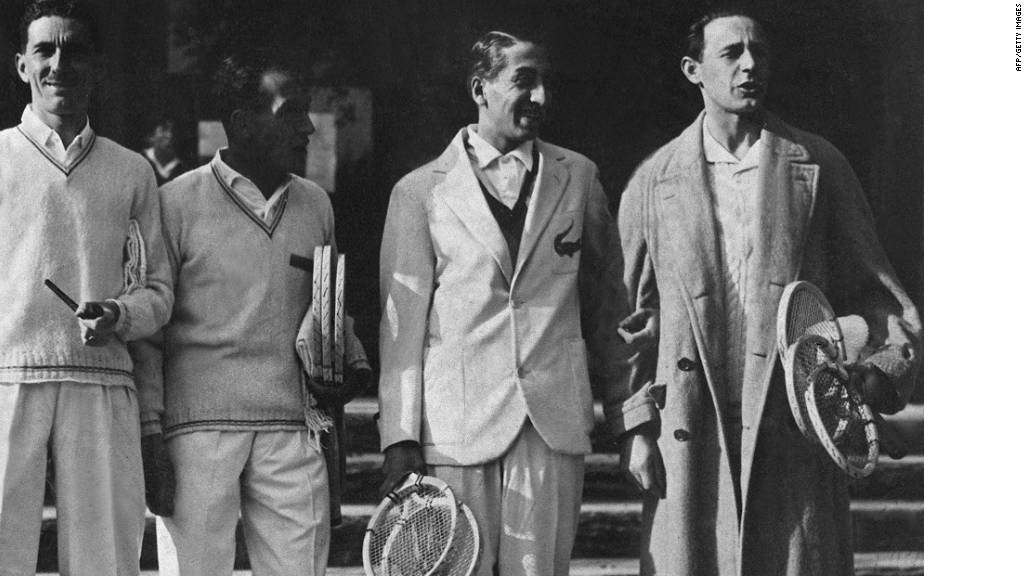
Jacques "Toto" Brugnon, Jean Borotra, Henri Cochet and René Lacoste in fact took French tennis global, winning five Davis Cups and winning the long awaited rematch at the new French tennis home in 1928 at Roland Garros. These Frenchmen went on to win an unprecedented five Davis Cups in a row.

The Four Musketeers who won The Davis Cup in 1928 at the new Roland Garros. Rene Lacoste already has the alligator. All they're missing are the ties!


The surface has never changed, and the maxim that the red clay is a leveler is surely appropriate. What's most interesting in looking at the list of Champions and even runner-ups is who is not there. Pete Sampras never won here, which in my book denies him from being the best player ever. The fact that Roger Federer has won this Championship only once speaks volumes. One of the best finesse players ever to take the court, Roger finally won here in 2009. Guess who only won once as well? Rod Laver who many say is the greatest player of all time won it just once - the year he won all the majors fortunately for him. And Ilie Nastase, who arguably was the greatest finesse player, won it just once.

On the women's side, people rarely note that among all her majors, Martina Navratilova just won it twice whereas the clay favored diminutive Justine Henin who took home the trophy on four separate occasions.

The list of Champions is surely a quirky statistic that we can reflect on every year as the red clay in Paris covers socks, ankles, racquets and balls. But there is an art to tennis when the tour makes its ultimate annual stop in what was once fields just to the South of the beautiful Bois du Boulogne. Even the cameramen for France 2 find artistic angles and views which I believe bring the viewer in closer to the action and help the television viewing world to feel just that little bit Francais.


Thus far this year's French Internationale, as it was called when they opened the tournament to non French Club players back in the early 20th Century, has not waivered too much away from the seeds. Upsets are coming I am sure and the quirky list that mark the Championship's winners I am sure will have another surprise in store for us this year.


Monday, May 20, 2013

The Evolution of the Grip and The Loss of The Continental

I was told one day years ago the following: Tennis was developed in Continental Europe and therefore the real first grip used was termed Continental. When the New World (i.e. New England) took on the sport of tennis, the Eastern grip was really developed on the East Coast of the United States. As you move the grip around the racquet, you move Western. The Western grips were established by West Coast American players and finally the Semi-Western and Full Western grips by the Australians.

Now, I cannot find anything to back that up, and the basis of the story may or may not be true. But, it's a nice story to use when teaching children tennis and geography and to use the sides of the racquet as a globe as you move around the world... and the racquet.

In doing some research, the 1860s saw the use of a Western Grip - and we thought it was a new grip in the 21st Century (well at least I did)! And perhaps my story above holds out as Californian Bill Johnston played our splendid game in the early 1900s and used his Western Forehand grip to help the USA win seven consecutive Davis Cups. His forehand was considered the best in the world at the time and he finally relinquished his number one American rank to Big Bill Tilden in the early 1920s.

The modern game of tennis sees most of the students learn a forehand first and usually, with an Eastern grip where the knuckle is straight behind the racquet's grip, taught primarily to help juniors with their groundstrokes. For years, through the 1960s and 1970s, many students of the game, initially held the racquet with a continental grip and then moved over to the Eastern grip. This is how I learned and, perhaps you may call it old school, there are some advantages to this progression or at least familiarization with the Continental grip.

Once we are out of our comfort zone at the baseline, the Continental grip is ubiquitous. In reality, any time one moves forward, the continental grip is really the grip of choice. There are several reasons for this and many of my students ask "When should I change?"

The only time I can think of keeping your full forehand grip, whether it be Eastern, Semi-Western, or Western as you move into the court and toward the net is on a ball that is presented to you above waist height where you can really hit top-spin on an approach shot. If the ball is low and forcing you to reach, well then the "Do the Continental with me..."

The Continental grip really forces the racquet head to angle upward underneath the ball at contact if contact is made in front of the body. Therefore on any low ball, requiring slice or simply to get it back up over the net, the Continental grip alleviates the flat racquet head position with the strings flush to the net which is caused by an Eastern or Western grip.

This comes in handy on a low approach or a low volley. I harken back to Andy Roddick, who too often didn't change to a Continental grip and one can remember how many balls would be caught by the net as he approached. The picture above illustrates this. The racquet head is flat to the ball and flush to the net, whereas a continental grip in the same situation would allow the strings to be angled upward.

One of the greatest players at the net and inside the court was Stefan Edberg. I had the opportunity to practice with him just prior to Wimbledon years back and at the net he was flawless. I use a more recent photo, but look at the Continental grip and the angle of the racquet as it approaches the ball.


Same ball, same place on the court... different racquet and hand angle due to the grip. In fact, I think you can spy his index finger up along the back of the grip. The next time you practice volleying, try just volleying with your index finger and thumb on the racquet and controlling the racquet head angle with the heel of your hand. Those three points of contact are really what control the racquet in a Continental grip, not fingers three, four or five.

Unfortunately, we teach the Eastern or Western grips all too often and all too long with our juniors who spend hours on the baseline. A good opponent, noting that you are not comfortable at the net, will bring you in to net and test that volley. Once you leave the backcourt, you leave that grip behind at the baseline. Andy found it hard to change and if he found it difficult to change, as one of the best players in the world, so is a junior looking to climb the rankings who doesn't practice it or learn it early on in development.

If one feels comfortable with the Continental grip, they can remain in that grip for even a return of serve if they feel they don't have the time to change grips on a service return. Once at net, no need to change grips between a backhand or forehand volley or an overhead. All Continental. Simplicity.

In each lesson, I try to reserve at least 15 to 20 minutes of the hour to working with a continental grip - whether it be for the volley, approach shot, overhead or serve. A good junior player, in fact any player, should feel comfortable with the Continental grip. And if you are an odds maker - well that's four strokes with a Continental grip compared to the one stroke for the other forehand grips.


Sunday, April 14, 2013

The Drop, Technology, Media and The Penalty of Being the Best and Worst in Sport

Technology, Media And A Penalty Drop

After his round Friday, Tiger Woods was just behind the leaders and thinking how he could overtake the leaderboard on the third day at Augusta. He received an early morning text message to meet with the Rules Committee and was told that he was receiving a two-stroke penalty for an improper drop.


The rule, in and of itself, is vague. The rule stipulates that after entering a hazard an option is to: "Proceed under the stroke and distance provision of Rule 27-1 by playing a ball as nearly as possible at the spot from which the original ball was last played." But, this is golf. Rulings are always complicated. But now, they take on even more complexity when the media, television and Twitter are involved.

A television viewer initially made contact with a Rules Official at Augusta noting that the drop on the 15th hole was in violation of the rule. The Rules Committee investigated and decided that no rule had been violated. Then, Tiger, as he does so often, said too much. In his television interview he said that he had dropped "two yards" behind his original divot and hit the same exact shot. The Rules Committee then decided that there was intent to achieve a better position and thus assessed the two-stroke penalty. All because of a television viewer and a television interview. My question, initially, was where was the Rules Official walking along with Tiger's threesome? Obviously not on the ball if he or she didn't notice a "2-yard" difference. In fact, it looked more like two feet in reality. But, then again, a good on-course official may have been able to avoid this whole issue. As a former official, I look at the official on the spot.

A friend of mine asked yesterday if Major League Baseball could have changed the first base call that cost a perfect game. First base umpire Jim Joyce cost Tigers' pitcher Armando Galarraga a perfect game back in June 2010 when, on replays, he clearly missed a call at first base on the last out. We all saw it. Major League Baseball and Jim Joyce had to stomach the mistake and move on. Viewers called. But there was no change in the call.

On Friday, viewers called, the Committee made an initial decision, viewers called, Tiger spoke, The Committee changed its ruling - it's hard being the best in the world. Everyone sees you and actually listens to you.

Did we see every swing of the club of Adam Scott on Friday? No. How about Angel Cabrera or Brandt Snedeker? No. But we saw almost every stroke that Tiger took, including the drop. If we hadn't, Tiger would be just two strokes off the pace. Being the best in the world has its drawbacks.

Technology, Tennis And The Penalty Of Being A Lower Ranked Player

While on tour with the ATP Tour as a chair umpire, a similar outcry came from the players who were not on the same level as the tennis Gods of the time: Jim Courier, Andre Agassi, Pete Sampras and Steffi Graf. The lesser players felt they were being penalized by Cyclops, and then Hawkeye. Now known widely as Chase Review, the system that can verify a ball being in or out at professional tournaments, the ball tracking system is not on every court at every tournament in the world. It usually is found on stadium court and perhaps another "show" court, as they term it in the industry. I find the term "show court" an interesting one as it denotes a difference from other courts.

Show Courts and Lesser Courts - all are used at tournaments but all do not have the same number of officials or Chase Review.


I always felt that lower-ranked players were penalized long before the Hawkeye system. On the tour, televised courts receive a bigger plethora of line umpires. If you look at a televised court, there are almost always three officials along the back screen on each side. One umpire calling the center service line and an umpire on each sideline. The non-show courts have just two officials at the back of each court and one official is required to run from the center of the court after calling the serve to the sideline. I know while I played, I found this quite distracting. As an official, I found it darned right difficult to cover that sideline after a 126 mile-per-hour serve.  But television, in its way, demands a bigger and better team of officials for the "show" courts. It demands Chase Review. And that actually makes for better line calls.

Walk, Talk and Walk

Sports personalities, as they gain insight into this media age, will do the walk on course or court, talk the interview and keep it short, and then walk away from the microphones. Twitter has, on so many occasions, created celebrity sports figures wide-ranging issues. As we pass through the Social Media century, I believe we will find that more and more celebrities and sports personalities will clam up. Tiger's post-round interview on Saturday was a lot shorter and a lot sweeter than normal. He probably doesn't want to get another two-stroke penalty, unwittingly.

As for us in the industry, we should perhaps revisit the rules of our individual sports and realize that perhaps instant replay is not always the way forward. Perhaps Major League Baseball has it right not allowing instant replay or review. The call on the field stays in almost every situation. The rules are part of the game on the course, court, field - wherever the game is played. The rules should stay on the course. They should not be subjected to the Twitter and Social Media fad, which will come and go. Golf, and its archaic rules, will be here a lot longer than Twitter, and even Tiger.


Sunday, March 10, 2013

Time To Make The Call

There are certain times of the year that bring into relevance how quickly time flies and how a year, which seemed to last so long when we were children, tends to shorten as we grow older.

My daughter just turned four this past week. For us in our 40s, a year goes by so much more quickly than when we took in everything as kids. My daughter said, "Daddy I was three for so long." Whereas to me, it seems like yesterday I was helping the nurse put sensors on my daughter's chest to ensure her heartbeat was regular after walking her from the delivery room. A former tennis partner once said to me years are simply shorter as you get older. She was right.

Years are marked in different ways: Holiday songs started to be played on the piano in our household around the 10th of December... Strawberries and cream in late June for Wimbledon weekends on the television... unpack the football or rugby ball in early September for those crips Autumn weekends.

But there is one, absolute moment, when I know summer is just around the corner. I am sure it is the same for many people who visit the islands in the summer months. It's the phone call to or website visit to The Steamship Authority - the company that ferries the throngs, the workers, the visitors and the islanders to Nantucket and Martha's Vineyard.

Three days in the truck ready to load on to the ferry.
There is a sense of calm when I look at the schedule and see four boats debarking from Woods Hole to Vineyard Haven four months away. There's always a bit of trepidation that all the ferries are going to be sold out, but somehow, even when sold out, there's a way those ferries fit most of the "standby" line alongside a truck or deep in the corner of the vessel.

I park my truck on the deck, stretch my legs after the three-day drive from Florida, go upstairs and grab a beer and head outside onto the passenger deck to watch the Vineyard appear over the horizon. Yes, that rock - it's still there a year later.

For years, I visited Nantucket. All through my post-college years, I rented a house on Surfside Beach in early September, after the throngs had departed back to their suburban homes. Nantucket felt more real at this time. Albeit having been there on July 4th to mark our country's birthday is a great day on the island, I prefer the quieter times on the island where I have unrestricted access to all of Nantucket's natural assets and beauty.

The same holds true for Martha's Vineyard. I arrive there in early June to "set up shop" and unpack for the three months during which I call the island home. Restauranters are remodelling for the season, white lines on tennis courts are being laid out, and there's only one boat working the three car ferry to Chappaquiddick - The Chappy Ferry. I have time to meet people and enter into real conversations in comparison to during the season when I gasp for air and collapse into my apartment at 7.30 to cook and sleep. So early June is the time to rest up, enjoy and relax with the possibility of experiencing all that such a wonderful, special island has to offer.
I've arrived.

It's a strange feeling indeed. When I turned my back on the Vineyard last September and boarded my ferry home, I couldn't wait to get onto the mainland. But now, I am looking back ready to get on that spit of sand once again and enjoy the summer months with friends and acquaintances I have made. It's like the conversation never ended and the 9 months on the mainland were simply a blink of an eye. How time flies as we get older.

I have new tennis drills and ideas ready for the season, goals set in terms of work and finance, but that seems to take a back seat to the evenings bicycling past the gorgeous homes with the warm, amber lights radiating out onto the cobbled streets.

And, unfortunately, the time flies by and before I know it, it's Labor Day. I'll be ready for the migration South, but will know this feeling will be around faster than my daughter's birthday in February.


Yep... back to the website. I think I'll go on the 10.45 from Woods Hole which gets me into Vineyard Haven for 11.30. Get some time to visit The Black Dog before I head over to Edgartown to let the summer begin.


Tuesday, January 22, 2013

Inauguration Day and an Inaugural Run At The Australian Open

New Year's Eve may come and go, but I always get a bounce in my step in mid-January every four years when the USA shows that we can do pomp and circumstance pretty well. We may not have a King or Queen, but we do lay out the red carpet for our president every January 20th.

This inauguration was no different and I watched intently as Barack Obama and the politicos in our nation's capital put on a show. I have to say, Beyonce Knowles has a set of pipes and the arrangement of our anthem, The Star Spangled Banner, was one of the best I have ever heard. If you haven't heard or seen it, here is the performance. Beyonce Knowles National Anthem

That aside, we Americans have some business "down under" in Australia, another "colony" which in fact still has The Queen as Head of State. In a very interesting match, the up and coming American Sloane Stephens, will take on Serena Williams on Wednesday in what might prove to be a match for the memories. The time is coming when Sloane will take over the American baton in this sport's relay and it might be at this tournament that she appears in the theatrical spotlight in this inaugural run in the first major of the year.

Sloane has the power and athleticism to compete with Serena who has been playing some of the best tennis of her career over the past two years. They both have power games and big serves. Stephens at the age of 19 is in her first major quarter final and in the biggest match of her career as of yet against her country woman. Serena and Sloane are friends and practiced together frequently while playing the Federation Cup.

Whereas Serena is playing through her matches quite easily, Sloane had some tough struggles to get to this point in the tournament and this may in fact serve her well as she has been tried and tested in the Melbourne stadium. Serena has not been and nerves will play a role here for sure.

She may not win her first quarter final tomorrow, and in fact Vegas has Serena as a heavy favorite, but I think Sloane's time is here and she will take that baton from Serena soon enough and it may be as early as 2013. I'll be tuning in late night.

Tuesday, January 1, 2013

Yemassee and a New Year

I have been thinking of this post and rewriting it as it has nothing to do really in regards to tennis. But as we turn the leaf over into 2013 it is always a good time to reflect.


One of the benefits in being a "seasonal" teaching tennis professional is that I get close to 4 months off a year. I enjoy this time with my family and I get some father/daughter bonding time before and after my 3 months working in Martha's Vineyard in the summer.

It's always tough to leave the family for an extended period of time. I had to travel to Singapore and Australia in my prior work leaving my wife back in the UK alone for up to a month at a time. But 12 weeks is a long time to be gone from one's home and family. My answer is: "Our American soldiers go farther away for a longer period of time and are doing jobs that endanger their lives on a daily basis." I am very lucky to be able to lead a life teaching tennis.

I do get to travel with tennis and I drive up and down the East Coast and once in a while I find a place that makes me realize how big a country we are and just how many cultures we have here in the USA. But then again, no matter where we are, we all have the same goals and objectives in life. One stop I made on my a recent migration was Yemassee, South Carolina.

I was on the hunt for gas as I had allowed the small gas tank light to come on and I had travelled off the beaten path this one morning of my journey. I had left behind most of South Carolina's back roads and was on Highway 17A when my tires rolled into Yemassee, South Carolina.


A town of approximately 1,000 people, Yemassee boasts one gas station that I could find: El Cheapo Gas.

Yemassee was the center of the Yamassee tribe of Indians up until the Yamassee war of 1715. Few towns boast a whole war with the town's name. As I drove down into the village, I noted Civil War encampments and fortifications by the roadside and I realized I was in the heart of a town that had a big Civil War history. In fact, all of the churches in town were burned during the Civil War except the Presbyterian Church which served as an army hospital for the Union soldiers.

The railroad passes through Yemassee and I learned that over 500,000 troops travelled through the Yemassee depot on their way to Parris Island and training just 45 minutes away. Yemassee has seen war and its ramifications in many ways over 2 centuries.

It's amazing to think, as you drive into what seems a small paradise, that the past and the events of war is never far away. Will 2013 see peace and prosperity? For those 1,000 people in Yemassee in their South Carolina small town through which AMTRAK rumbles through twice daily, life is no different than those of us in bustling South Florida and our 6 lane I-95 just 400 miles or so South. Cultures may vary and accents may have different twangs but we worry about peace, we tend to our families and friends and we live with our faults and strengths, our memories and our future, of which 2013 is just a stepping stone.

Sunday, December 9, 2012

30 Years On And We Still Miss Him: John McEnroe & The Complete Player

I was having dinner with my sister last week and she was asking for events that had happened exactly 30 years ago in the tennis and golf sphere as we are both employed in the country club industry. So, where else to start but type into Google: Wimbledon winners, 1983


John McEnroe defeated New Zealander Chris Lewis. Remember Chris? I didn't. He beat one of my favorite players South African Kevin Curren in the semi final. Lewis was only the second New Zealander to ever make a final and was unseeded. McEnroe ended Ivan Lendl's tournament in straight sets in the other semi-final. Tougher match for sure.

It was a good year at Wimbledon. But what I noted was who won the doubles: John McEnroe and Peter Fleming defeated the American brothers Gullikson. Guess what? Big Mac did the same thing in 1984 taking home the singles title after beating Jimmy Connors in the final. McEnroe and Fleming again won the doubles against Australians Pat Cash and Paul McNamee. That's four Wimbledon titles in 2 years. I didn't look at mixed. The story was there. On the men's side McEnroe and Fleming were just complete players. At the same time, Martina Navratilova and Pam Shriver were doing similar things on the women's side. They just don't make tennis players this complete anymore. When was the last time, I asked, that the men's singles player also won the men's doubles title at Wimbledon? You guessed it. John McEnroe.

Perhaps it's me looking back at the history of the game I love with rose-tinted glasses - I actually wear contacts now for those high school friends who read my ramblings. Perhaps I am not giving enough credit to the players of today - Serena and Venus play the singles and doubles at most of the major events. But they just don't play that many events.

Fleming and McEnroe won four doubles titles at Wimbledon and three at the US Open. All the while Fleming maintained a top-ten singles ranking and McEnroe stayed either at the top of the rankings or in the top three. We wonder why McEnroe is such a great commentator - he was not only a fantastic player, but perhaps one of the most complete players we have ever seen.

If you look back at his time on the tour, McEnroe may be remembered for his behavior, but in reality we should remember him for his fabulous, yet unconventional serve, his simple and effective groundstrokes and his amazing hands while volleying at the net.

To look closely at his forehand, it's so simple and relies on his great eye-hand coordination rather than power. He forfeits any type of a loop backswing, taking the racquet directly back to the low position before he comes up to meet the ball rather flatly, using the pace of his opponent in most cases to hit back with speed. Have a look here:
Perhaps you could out finesse the Big Mac and not allow him to use his power? Only one player was able to do this: Guillermo Vilas who won more matches then he lost against the Big Mac.Vilas was another great who is largely overlooked. He won seven, yes seven, consecutive titles, following Wimbledon right through and past the US Open. Most players today don't play seven tournaments in a similar 8 to 9-week period. Oh, Vilas played doubles too. This was the era of the complete player - on any surface and in singles and doubles and at the baseline and at the net.

This match, against Stefan Edberg, perhaps proves the finesse and yet, the power too with picking winners cross court and down the line by both players. Look at how both exploited the weakness of their opponent and used their own strengths to create and build a point.


The legacy of McEnroe is enormous as we think of his serve and volley game combined with fabulously simple ground strokes. McEnroe remains perhaps the leading example of the complete player and perhaps that is why we either love him or despise him as a commentator. He is perhaps the greatest tennis commentator of our time for the BBC in Britain and back here in the USA with insightful tips and great understanding of the minutiae of a match or point.

When asked to perform an impersonation, Novak Djokovic often mimics Johnny Mac and his unorthodox serve. Djokovic's imitation alone proves just what an icon McEnroe was in his time because in 1983, thirty years ago, Djokovic wasn't even around yet.

Wednesday, November 14, 2012

A Fitting Finale in London: Djokovic versus Federer

It's a bit like how the season has gone for these two - close and closer and closest. It may not be a year for either Djokovic or Federer to remember and put at the top of their resumes, but the two giants of the ATP Tour really treated us to a finale yesterday in London's O2 Center which was tennis at its best. Each had won a Grand Slam this year, Djokovic winning in Australia and Federer taking another title at Wimbledon. So this match was going to settle the score at the end of the season.


Think about this: Federer didn't lose a point to the Number One player in the world until the third game. And that said, Federer was already 25% of the way to the final destination, a win, within 9 minutes and up 3-0. But like a horserace, there is no clock and Djokovic started to chip away and get the older Federer into longer and longer rallies, which favored the 25 year-old Djokovic. Before you could blink, Djokovic was winning the first set in a tiebreak and went on to win the match in two straight sets.

This was the second time in two days that Djokovic had come back from what looked like a losing proposition. The previous day, Juan Martin Del Potro had Djokovic on the ropes yet again. Djokovic, losing the tempo on his serve, was watching the 6 foot 6 inch Del Potro move well within the baseline and take the second serve waist high. Djokovic lost the first set without much of a whimper. It looked again like Djokovic was going to be beaten badly... and yet, he came through the 3-set match a winner.

It really showed here at the end of the season what we knew at the beginning of the season when Djokovic beat Nadal in that 5 hour 53 minute epic in The Australian Open final: No one can actually outhit Djokovic over an entire match. There might be spells and games where one can push him back, but over the course of three or five sets, Djokovic's groundstrokes will outlast his opponents if his mental state remains sober and focussed.


Sunday, October 21, 2012

To String Or Not To String: That Is The Question

This is probably the question I am asked the most at this time of year. Between summer and winter seasons, we as players are left to ponder how strings and tension might be affecting our game. The debate is continually ongoing and there is never a right or a wrong answer.
The general rule of thumb is to restring your racquet each year the number of times you play in a week. If you play three times a week, the general rule would therefore be to restring your racquet three times. But even this general rule doesn't always work or make sense in relation to one's game.

So, you ask, what is appropriate?

To discuss the professionals, the trend has been to lower the string tension. Back in the day of Jimmy Connors or Pete Sampras, the tension would have been up near or even above 70 lbs. But nowadays, the tensions have been coming down. With powerful new racquets, there is no need to string as high as we once did. For example, the professionals probably use a new string job for just a set, if that. They may change more frequently. They have professional stringers on site to manage their many racquets and use string that is not always conducive to a game at club level. Strings deaden quickly at such a pace and frequency of hits. But what about us mere mortals on the court? How do we know when our strings are dead?

The number one priority in stringing for play at any level is the actual "playability" of your strings in conjunction with your game. Too often we look at what others are doing or what the professionals are doing in terms of string and tension, but that might not suit your own, personal game. 

If you hit with more topspin, you might look to restring a bit more as the strings become frayed as there is more gripping of the string required as it makes contact with the ball on each stroke. The more you hit low to high, the longer the ball remains on the strings. Oftentimes, customers come up to me and say, my strings are done - they are moving. Well strings do move and the pattern will change shape if you are hitting with a good amount of topspin. If you hit flat, you may get away with fewer restringings as the string stays intact longer as the ball is not on the strings for as long a period.

Different types of strings have various stretching tendencies. The popular Sensation or NXT from Wilson Tennis stretch a lot more than Wilson's Luxilon string, which is more wire-like. Strings that stretch offer more control but need to be replaced more often 

The answer to whether you should restring is a personal one based on use and type of string and how your game is progressing. The best way forward is to ensure that you feel comfortable with the strings in your racquet. If not, change them out and restring or test something new with a demo of your own racquet strung differently. But by lowering or raising your tension or changing string it's a whole new game. It's trial by play!